In the history of American Presbyterianism, there are three constants during seasons of revival: the desire to see conversions and social, cultural, and spiritual renewal, debates on exactly what that should look like, and division. During the First Great Awakening, the Old Light-New Light debate regarding revival and confessionalism led to the split in the Colonial Presbyterian Church. At the center of this was Gilbert Tennet’s revival preaching. He popularized the preaching of terrors (preaching the horrors of hellfire and condemnation), holding the mirror to the hearer’s soul (showing someone why they personally deserve condemnation), and the searching method (removing any perceived obstacles to conversion through persuasion).(1) This position about preaching culminated in Tennent declaring that most other preaching was not only inadequate, but the sign of an unconverted ministry.(2) And the following year, 1741, the split became official at the Synod.(3) The two sides would remain divided until their reunion in 1758.
That was not the last time a revival-driven innovation led to a split in the Presbyterian Church. Leading up to the mid 1830’s, Charles Finney found himself in a similar position as Tennent. He had stepped into his own controversy because of his views on revival, theology, and his promotion of the New Measures. The debate would result in the New School and Old School division.(4) Numerous issues caused the break between the New School and the Old School Presbyterians. To the Old School Presbyterians, the New School revivalism was emotionally manipulating,(5) erroneous theologically,(6) and undermined the polity of the church (especially when considering missionary work and other interdenominational partnerships).(7) Whereas the New School saw the innovations as the continuation of Pentecost and acceptable as the Holy Spirit endows the church with gifts in its own specific epoch.(8) Finney’s frustration with the Old School Presbyterians regarding the revivals was clear; he wrote in 1835 following The Act and Testimony, “No doubt there is a jubilee in hell every year, about the time of the meeting of the General Assembly.”(9)
It could be assumed that such animosity between the two groups meant that all Old School ministers rejected the New Measures, while the New School accepted them wholesale. However, this paper argues that the ministerial reception and use of the New Measures varied considerably within the Old School. This is contrary to common interpretations, which portray Old School Presbyterians as rejecting the New Measures nearly unanimously.(10) While some indeed rejected them outright, like Charles Hodge and William Engles, other leading Old School ministers, including Daniel Baker and Samuel Miller, showed varying degrees of acceptance of the New Measures. Therefore, the dividing line was not primarily the practices used in revivals but rather theological, ecclesiological, and confessional presuppositions.(11)
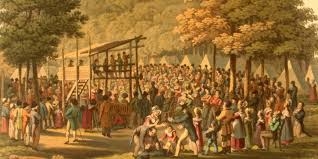
The New Measures included numerous practices, but the most prominent, and controversial three that will be discussed in this paper are the following: First, anxious meetings, during which the revivalist preachers would meet with individuals or groups to hear their anxieties, which would later be addressed during preaching.(12) Second, protracted meetings, long drawn-out services, or camp meetings over several days or weeks, to promote emotional response and a conviction of sin.(13) And third, the anxious seat, which was placed in a prominent spot in the congregation, and those who felt conviction would sit there and receive instruction or prayer, with the hopeful result being repentance and conversion.(14) To prove the thesis, this paper proceeds in two stages. First, it briefly examines the historical and theological issues building up to the New School Old School controversy and the main emphasis of Hodge’s Old School arguments. And second, it surveys leading Old School representatives and leaders and their response, reception, modification, or rejection of the New Measures. The conclusion assesses the outcome of the debate to prove that the main issue was not the practices of revival, but the differences in theology, ecclesiology, and confessionalism.(15)
The Context of the Old School New School Split
The split between the Old School and New School would go back to the issue of confessionalism and the subscription to the Westminster Standards.(16) Charles Hodge would find himself at the center of the debate for the majority of his theological and writing career. As Fortson summarizes, “for Hodge, the debates between the two major parties of the Presbyterian family always came back to the question concerning the extent to which ministers should be expected to hold the doctrines of the Westminster Standards.”(17) The Plan of Union (1801) allowed fellowship between churches and the transfer of ministers between Presbyterians and Congregationalists.(18) This plan opened the door to men who normally would not have attempted ordination in the Presbyterian Church, including Charles Finney.(19)
However, this union would also allow Yale-trained ministers who had adopted aspects of Hopkinsian, and the General Assembly would spend much time debating the issue. In 1817, the General Assembly would debate the issue and oscillate between condemnation of the doctrine, and acceptance as it being a scruple, the Assembly voted to “call to an account all such ministers as may be suspected to embrace any of the opinions usually called Hopskinsian… the Assembly regret that zeal on this subject should be manifested in such a manner as to be offensive to other denominations and… to introduce a spirit of suspicion against ministers in good standing.”(20) This division would only grow as key theological differences emerged in the 1820’s and early 1830’s.
Finney would practice the New Measures in his revival ministry in Utica, New York, in 1826 to major numerical success.(21) However, the New Measures are not where the majority of criticism would originate, but because his “theory of revival that flew directly in the face of the Westminster Standards’ Calvinism.”(22) Finney would deny original sin, imputation, total depravity, condemnation for the sin nature, and affirmed a universal atonement (with the caveat that this did not require God to redeem anyone).(23) The issue was not just that this was Finney’s personal view, but was the “emerging theological consensus in New England Congregationalism.”(24)
Even with such theological disagreements, Hodge approached the debate hoping that there would not be a split between the Old and New Schools.(25) Hodge would respond to the New School position, arguing in favor of the historic Calvinistic view of regeneration(26) and in favor of subscription to the system of doctrine in the Westminster Standards.(27) For Hodge, one of the key leaders in the Old School, this was the essence of the debate between the two sides regarding revival. It was not that one or the other wanted revival or not, but that the theological camps disagreed on key doctrines that would result in different emphasis during preaching, communion, liturgy, and interdenominational work.(28) It is in that context that the following authors discussed the New Measures.
Old School Presbyterians and Their Varied Reception and Use of New Measures
The following sections detail key writings related to the New Measures from Old School leaders. Each shows a differing level of acceptance of the New Measures while expressing concern about the theological presuppositions of the New School. William Morrison Engles rejected them as a manipulative and dangerous system. Samuel Miller rejected some, but gladly approved of protracted and camp meetings. And Daniel Baker approved of major New Measures, including protracted meetings, inquiry meetings, and even the anxious seat when done in temperance and in good order.(29)
William Morrison Engles (1797-1867)
William Morrison Engles was a staunch supporter of the Old School party and was the editor of The Presbyterian from 1834 to 1863. He argued against the New Measures in his article Dangerous Innovations.(30) Just as the majority of the Old School, Engles was pro-revival. His concern was the excesses and novelty of the New Measures, “Now we wish it to be distinctly understood, that we question neither the piety nor the integrity of those who first introduced, or who still abet, these practices, but we feel persuaded, that they have given impetus to a machinery which, in its wild and frantic movements, will soon defy the control of any adjusting or regulating force.”(31) He continued that “there is another preliminary remark of some importance, and it is this: The resistance of these measures cannot fairly be construed into
hostility to revivals.”(32)
The issue for Engles was that the methods were developed out of an improper understanding of theology, “The point of doctrine upon which their chief reliance is placed is that every sinner has inherent ability to make for himself a new heart, and that he can, at any moment, become a Christian, if he wills it.”(33) This is the exact sentiment of Charles Hodge, “No more soul-destroying doctrine could well be devised than the doctrine that sinners can regenerate themselves, and repent and believe just when they please.”(34) And was summarized in the Old School General Assembly motion the Act and Testimony in 1835, condemning the theology “that teaching man’s regeneration is his own act; that it consists merely in the change of our governing purpose, which change we must ourselves produce.”(35) This also supports Hart and Muether’s thesis regarding revivalism and the Old School.(36)
In Dangerous Innovations, Engles specifically critiqued the protracted meetings, saying “notice is previously given to a congregation that a protracted meeting will commence on a given day, and that certain ministers, who have signalized themselves in many remarkable revivals, will be present to conduct the meeting.”(37) He walks the reader through this practice, “the long-expected day at length arrives; gossip is busy; the people are upon the qui vive, and their exercises commence under the most auspicious circumstances.” And questions the purpose of such a session, “But what now appears to be the great aim of the leaders? Is it to enlighten the mind and to affect the heart by an intelligent and impressive exposition of Gospel truth? No, but their addresses, their hymns, and their tunes are all adapted to work upon the feelings of the nervous and sanguine, until animal excitability is brought into full play.”(38)
He then dismissed the anxious bench and the practice of coming forward in general. “Those who are anxious and wish the prayers of the church are invited to come forward and occupy the anxious seats which are specially reserved for them. Here prayer is offered, often most irreverent in its style, hymns of an exciting character are sung, and the anxious are stunned with the perpetual reiteration of the command, submit or be damned!”(39) He concluded his illustration of protracted meetings:
In the blind enthusiasm of such moments, we have known a general invitation to be given to all who wished to be baptized to present themselves and receive the ordinance, without previous question or examination. And we have heard of one who was an atheist on Friday, and who, presenting himself on the Sabbath, was admitted to the Lord’s table without examination, and with the concurrence of the officiating minister. Such proceedings have been dignified with the name of revivals, and the accounts of them have been blazoned through the land, that the spirit of them might be diffused, and the example prove contagious.(40)
The spiritual conclusion to the New Measures, according to Engles, was that “they tend to render people unimpressible by the ordinary means of grace, and thus augur unfavourably for the future prosperity of the Church.”(41) Engles, therefore, represents the often assumed position of the Old School Presbyterians. Yet, even his critique shows that his issue with the methods is foremost the theological assumptions of the New School proponents. He denounced the New Measures as the bad fruit of the New Schools’ rejection of robust confessionalism regarding human ability and regeneration, which he believed was infiltrating the Presbyterian Church and would lead to great harm.(42)
Samuel Miller (1769-1850)
Samuel Miller was an Old School bulwark and respected Princeton professor. He was instrumental in the ecclesiastical fights of the 1830’s in the Presbyterian Church, and most famously the trial of Albert Barnes.(43) Among his anti-New School writings, his two letters Revival of Religion provide the clearest summary of his views on the New Measures.(44)
Miller was in favor of true revival, writing “In my opinion, every professing Christian ought to consider the degree in which he longs, and prays, and exerts himself for the revival of religion, and for the extension of the Redeemer’s kingdom, as affording one of the most undoubted and unerring tests of his piety.”(45) And speaking on behalf of his Presbyterian brothers, “If we wish our beloved Church really to prosper, let us never cease to long and pray for revivals of religion.” And “I know not of a single Synod, or even Presbytery in our whole body in which revivals of religion are not constantly and fervently prayed for, and really desired, and would not be cordially welcomed.”(46)
Revivals as such were not his concern; in fact, they were his hopeful expectation.(47) Rather, he spoke against what he would argue was emotionalism and the manipulative tactics of the New School. He wrote, “It is no uncommon or difficult thing to work upon the animal feelings of assembled multitudes, by mere terror, by sympathy, by vehement addresses, by fine music, by a great variety of means in which Gospel truth is not presented, and has no influence.” And “It is surely unnecessary to remark, that such revivals are a disgrace to the name; that they are the fruit of animal excitement merely; and that every enlightened friend of the Redeemer’s kingdom, must mourn over their character and tendency.”(48) According to Miller, if a believer should pray for true revival, then they must also mark and avoid the false revivalism of the day.
Miller did not ground true revival or heart change in a system such as the New Measures, but in the fidelity of the preaching, teaching, and fruit in relation to the Gospel applied by the Holy Spirit.(49) He wrote, “If I were called upon to say what I mean by a genuine revival of religion, as distinguished from a spurious one, I should draw the line of distinction by saying that a genuine revival is one which is produced by the exhibition of gospel truth, faithfully presented to the mind, and applied by the power of the Holy Spirit.”(50) Miller’s letter confirms Marsden’s thesis that the Old School was not opposed to revival, but was concerned with the theological underpinnings of the New School, which produced the New Measures.(51) Miller confirms it again
in the following quote:
For, as there can be no real piety in any individual heart without the reception and love of the fundamental doctrines of the Gospel; so we must estimate the real character of every religious excitement which claims to be a revival, by the degree in which pure Gospel truth is presented, embraced, and obeyed. However widespread and powerful the excitement may be, it ought ever to be brought to this obvious, fair, and decisive test: Is it produced by a blessing on the truth plainly and faithfully presented? Is it throughout regulated by the truth? And do its professed subjects manifest a general and cordial love of Gospel truth? Are their views of the character of God, of his holy law, of sin, of the ground of acceptance, and of Christian hope, — I do not say perfectly — but in the main, accordant with the Bible views of those great subjects?(52)
Miller specifically spoke against the anxious seat as an error and destructive.(53) He felt “constrained to add, that when this highly exciting system of calling to “anxious seats,”… is connected, as, to my certain knowledge, it often has been, with erroneous doctrines;—for example, with the declaration, that nothing is easier than conversion;—that the power of the Holy Spirit is not necessary to enable impenitent sinners to repent and believe…” and “statements as these, it appears to me adapted to destroy souls by wholesale!… It is, I sincerely believe, a system of soul- destroying deception!(54)
However, considering such polemical language, Miller did not disavow all of the New Measures. He wrote about protracted meetings (including camp meetings) saying “To exemplify my meaning: I am a warm friend to ‘Protracted meetings…’ days of our blessed Lord’s personal ministry, we know that He kept the people hanging on his lips for three whole days in succession, and, during the greater part of this time, large numbers of them evidently remained on the ground fasting.”(55) And “It was on such an occasion that a single sermon, by the celebrated Mr. John Livingston, was blessed to the hopeful conversion of five hundred souls. And such protracted meetings have, beyond all doubt, been made singularly instrumental in many parts of our own country, especially within a few years past, to the commencement or the continuance of the most precious revivals of religion.”(56)
While being in favor of protracted meetings, Miller does warn against abuse of making them a new type of sacrament,(57) especially when they are “regarded as a kind of machinery which may serve as a substitute for personal religion, and persevering devotion; and, finally, they are greatly abused when they are resorted to so frequently by the same people, as to convert them into stated means of grace, and thus to make the Sabbath, and its ordinary privileges lightly esteemed in comparison with them.”(58) His exhortation to the Old School Presbyterians became “Employ protracted meetings. They are fully warranted by the example, as well as the spirit of the word of God. But do not make idols of them. Do not imagine that they have an inherent efficacy, independently of the Spirit of God, to produce a revival of religion.”(59) And when hosting them to “prepare for them with much humble, importunate prayer. Remember that, like all other means, they will only be useful as far as they are attended upon with a believing reference and application to the Spirit of all grace. And be careful not to view or use them in any way which will tend to depreciate in your esteem the ordinary means of grace.”(60)
Miller’s nuanced position demonstrates that Old School Presbyterians distinguished between legitimate and illegitimate uses of revival measures rather than rejecting revival methods wholesale. As one of the founders of Princeton Seminary and a key Old School Presbyterian, Miller’s favourable position on protracted meetings allowed for Old School ministers to adopt some of the New Measures in good conscience. So while there were debates on the methods, Miller’s writing suggests the Old School was more concerned with the New School’s alleged confessional and theological departure than debating which New Measures were acceptable.(61)
Daniel Baker (1791-1857)
Engels’ Dangerous Innovations shows that he denounced the New Measures as a whole. While Miller’s two letters posit that, while he was opposed to them broadly, he accepted and promoted protracted meetings. Daniel Baker represents a third category of Old School minister. While Engels rejected them outright, and Miller was selective and approved of protracted meetings, Baker accepted and practiced many of them. Baker evaluated the effectiveness of revival measures based on their usefulness in proper worship and preaching. Because of this, he accepted several practices commonly associated with the New School. Robert Winter and others have highlighted Baker’s effectiveness in the frontier and ministry.(62) Baker would preach numerous revival sermons and later explained his methodology and willingness to employ such measures in a letter to a friend in New York.(63)
Baker would himself lead many protracted meetings; one in Beaufort, South Carolina, saw him preach there for 10 days.(64) Baker described the meetings as a blessing, “O what blessed meetings we had! Three times a day did I preach, and every Day and night to full houses. Besides, it was usual to have what was called a ‘concert of prayer’ at the going down of the sun.”(65) And the meeting was attended by believers of different denominations and backgrounds. “The union of sects produced on the occasion was not the least striking feature of the event. Distinctions were laid aside. Christians of all denominations met and worshipped together, indiscriminately… and the cordiality of their mutual attachment was a living commentary of the great precept of their teacher, ‘Love one another.’” (66) Speaking about the effectiveness of protracted meetings, Baker wrote, “if you choose to term it such, has usually had a remarkably happy effect.”(67)
Baker did address the issue of emotionalism in revivals, but did not allow for reports of them to undermine the promotion of revival. He wrote, “In about eighty revivals of religion, averaging thirty converts each, I do not suppose there were more than eight cases of outcries; and in nearly all of them order and stillness were immediately restored.”(68) Baker goes on to state that he was against the anxious bench at one point in his ministry, but came around to see the value of it when addressing sinners,
When certain individuals are known to be under serious impressions, an invitation is sometimes given, on peculiarly solemn occasions, for those who are serious, and who desire an interest in the prayers of God’s people, to come forward, or kneel at their seats.” This measure I once did not approve, but experience has taught me that it has a tendency to break down the pride of the heart, give decision of character.(69)
This statement challenges the common notion that all Old School ministers disavowed the anxious bench, such as the following, “Baker and other Old School revivalists were careful to see that conversion came by means of an intelligent appeal, rather than through psychological inducements such as the anxious seat (a pew near the pulpit, reserved for those concerned about their spiritual condition) or emotional singing.”(70)
Baker not only approved of the anxious bench, but of anxious meetings before or after preaching, “The invitation is sometimes given in the great congregation, but more generally in meetings of a more select and private character. Inquiry, or anxious meetings, have been found much called for, and of great benefit.”(71) And
…frequently the accounts which are given of protracted meetings and revivals, are too highly coloured, and sometimes there is a freedom of remark indulged in, which, to say the least, is not good to the use of edifying. Alas, poor human nature! Everything is stamped with imperfection in this world…..But so many persons are converted at the same time ! Is it not all sympathy ?” The work is the work of God, and surely He that originally grouped the stars in the firmament of heaven, can with equal ease, group those who are to shine as stars for ever and ever. ” But is there not a great deal of extravagance ?” No, not if the ministers are prudent, and the meetings are properly conducted, and closed at proper hours.(72)
He also spoke to the regular occurrence of spurious conversions, “but are there no spurious conversions?” There may be. And are we not taught to expect such things in the 13th chapter of Matthew? Spurious conversions! And are all pure gold who come into the church when there is no special excitement? Spurious conversions!”(73) And anecdotally denounced the claim that spurious conversions rarely resulted in fruit, another common Old School retort. Baker wrote, “according to a calculation which 1 have made, only about one in fifteen or twenty of those hopefully converted, fall away.”(74) Finally, Baker admitted there may have been times when he erred, and put a caveat that measures are only beneficial depending on the context. He closed his letter saying, “I must confess I have seen some things practiced which I could not approve. With regard to myself, I may have erred, but my rule has been to confine myself to no set of measures whatever; for my opinion has been and still is, that a measure which might be useful in one place, may be positively injurious in another.”(75)
Conclusion
Looking at the writings of Engles, Miller, and Baker, it is clear that there were distinct practices and views of the New Measures in the Old School. Engles rejected them unilaterally and warned of their danger in the church. Miller accepted protracted meetings with caveats of idolatry and manipulation. And Baker saw them as valuable tools as long as they were done in good order and with proper theological grounding. However, even with the differences in practice, all three ministers aimed to promote revival through the confessional practices of their church. This evidence reframes the assumption that Old School Presbyterianism automatically meant a rejection of the New Measures. Engles, Miller, and Baker show that even with a highly confessional system and camp, there is room for differing applications of the Calvinism of the Westminster Standards. Therefore, the connection point between the Old School was not practice, but systems of doctrine.
This evidence reframes the split between the two sides, suggesting that specific revival practices were not the primary cause of the controversy and separation, but an effect of the underlying theological and ecclesiological debates. This opens the door for more research into the actual practices of the Old School Presbyterians and the extent to which those overlapped with New School proponents. Such research may reveal that the practical differences were less obvious than the theological differences that separated them.
Footnotes
(1) Milton J. Coalter, “The Radical Pietism of Count Nicholas Zinzendorf as a Conservative Influence on the Awakener, Gilbert Tennent,” Church History 49, no. 1 (1980): 41-42.
(2) Gilbert Tennent, The Dangers of an Unconverted Ministry (Philadelphia: Printed by Benjamin Franklin, 1740).
(3) Guy S. Klett, ed., Minutes of the Presbyterian Church in America, 1706–1788 (Philadelphia: Presbyterian Historical Society, 1976), 174.
(4) George M. Marsden, The Evangelical Mind and the New School Presbyterian Experience (New Haven: Yale University Press, 1970), 60-62.
(5) “Act and Testimony, Adopted by the Synod of Philadelphia, and Signed by Ministers and Elders in Behalf of Convention of the Presbyterian Church in the United States, Held at Pittsburgh, May 1835” recorded in: Samuel J. Baird, comp., A Collection of the Acts, Deliverances, and Testimonies of the Supreme Judicatory of the Presbyterian Church: From Its Origin in America to the Present Time; With Notes and Documents Explanatory and Historical, Constituting a Complete Illustration of Her Polity, Faith and History (Philadelphia: Presbyterian Board of Publication, 1855), 675.
(6) Isaac V. Brown, A Historical Vindication of the Abrogation of the Plan of Union by the Presbyterian Church in the United States of America (Philadelphia: W. S. & A. Martien, 1855), 89., & Marsden, The Evangelical Mind, 60.
(7) Minutes of the General Assembly of the Presbyterian Church in the United States of America, 1836 (Philadelphia: Presbyterian Board of Publication, 1836), 280. (Here after referred to as Minutes).
(8) Charles G. Finney, Lectures on Revivals of Religion, (New York: Leavitt, Lord & Co., 1835), 262
(9) Finney, Lectures on Revivals of Religion, 269.
(10) This is the basic assumption in the seminal work Whitney R. Cross, The Burned-Over District: The Social and Intellectual History of Enthusiastic Religion in Western New York, 1800–1850 (New York: Harper & Brothers, 1950),173-178 & 256-267.
(11) Historians tend to agree that the main issues were not about “revival.” One side was not “anti-revival” or the other “pro-revival.” Both aimed at renewal, but the issue was focused on polity, theology, and new views that undermined confessional Calvinism (according to the Old School). See: Marsden, The Evangelical Mind. & D. G. Hart and John R. Muether, Seeking a Better Country: 300 Years of American Presbyterianism (Phillipsburg, NJ: P&R Publishing, 2007), 112-117.
(12) Finney, Lectures on Revivals of Religion, 262.
(13) Finney, Lectures on Revivals of Religion, 262. This paper will consider camp meetings as a form of protracted meetings, as the terms were often used interchangeably by both opponents and proponents of the New Measures.
(14) Finney, Lectures on Revivals of Religion, 267.
(15) Mark Noll expertly draws out the changes that occurred in the 18th-century and how the New Measures developed out of the democratization of the Christian and rapidly shifted American Christianity. .Mark A. Noll, America’s God: From Jonathan Edwards to Abraham Lincoln (New York: Oxford University Press, 2002)
(16) To fully cover all aspects of this topic is beyond the scope of this paper, the aim, therefore, is to give the background debate between Hodge and Finney as the summary of Old School New School disctinctives.
(17) S. Donald Fortson III, “The Old School Sage: Charles Hodge on Confessional Subscription,” in Reformed Faith and Practice, ed. J. V. Fesko (Phillipsburg, NJ: P&R Publishing, 2015), 40.
(18) “Plan of Union, 1801,” in Samuel J. Baird, comp., A Collection of the Acts, Deliverances, and Testimonies of the Supreme Judicatory of the Presbyterian Church: From Its Origin in America to the Present Time; With Notes and Documents Explanatory and Historical (Philadelphia: Presbyterian Board of Publication, 1855), 570.
(19) Hart and Muether, 300 Years of American Presbyterianism, 111.
(20) “Minutres of the General Assembly 1817,” in Samuel J. Baird, comp., A Collection of the Acts, Deliverances, and Testimonies of the Supreme Judicatory of the Presbyterian Church: From Its Origin in America to the Present Time; With Notes and Documents Explanatory and Historical (Philadelphia: Presbyterian Board of Publication, 1855), 570.
(21) Cross, The Burned-Over District, 173.
(22) Hart and Muether, 300 Years of American Presbyterianism, 112.
(23) Hart and Muether, 300 Years of American Presbyterianism, 112.
(24) Hart and Muether, 300 Years of American Presbyterianism, 113.
(25) Fortson III, “Charles Hodge on Confessional Subscription.” 40.
(26) Charles Hodge, “Review of Regeneration,” Biblical Repertory and Theological Review 2 (1830): 1-48.
(27) Charles Hodge, “Remarks on Dr. Cox’s Communication” in Biblical Repertory and Theological Review III (1831): 482-514.
(28) Marsden, The Evangelical Mind, 79-87.
(29) It is beyond the scope of this paper to examine a large portion of Old School Presbyterians and their views regarding the New Measures. This selection covers the major levels of reception from respected and key leaders from both the North and South.
(30) William M. Engles, “Dangerous Innovations,” Biblical Repertory and Theological Review 5, no. 3 (July 1833): 323–333.
(31) Engles, “Dangerous Innovations,” 323.
(32) Engles, “Dangerous Innovations,” 324.
(33) Engles, “Dangerous Innovations,” 325.
(34) Charles Hodge, Systematic Theology, vol. 2 (New York: Charles Scribner & Co., 1872), 277.
(35) Act and Testimony, 677.
(36) Hart & Muether, 300 Years of American Presbyterianism, 112-114.
(37) Engles, “Dangerous Innovations,” 325-326.
(38) Engles, “Dangerous Innovations,” 326.
(39) Engles, “Dangerous Innovations,” 327.
(40) Engles, “Dangerous Innovations,” 327-328.
(41) Engles, “Dangerous Innovations,” 331.
(42) Marsden, The Evangelical Mind, 69-70.
(43) Minutes, 320.
(44) Samuel Miller, Letters Concerning the Present Crisis in the Presbyterian Church in the United States (Philadelphia: Anthony Finley, 1833), 151-191.
(45) Miller, Letters Concerning the Present Crisis, 153.
(46) Miller, Letters Concerning the Present Crisis, 190.
(47) Miller, Letters Concerning the Present Crisis, 153.
(48) Miller, Letters Concerning the Present Crisis, 154-155.
(49) Paul Kjoss Helseth, “Samuel Miller on the ‘Sanctified Judgment’ of the Enlarged, Elevated, and Strengthened Mind: Piety, Learning, and the Right Kind of Bias,” Themelios 47, no. 1 (2022): 105.
(50) Miller, Letters Concerning the Present Crisis, 154.
(51) Marsden, The Evangelical Mind, 75-76.
(52) Miller, Letters Concerning the Present Crisis, 161
(53) Miller, Letters Concerning the Present Crisis, 173.
(54) Miller, Letters Concerning the Present Crisis, 165.
(55) Miller, Letters Concerning the Present Crisis, 175.
(56) Miller, Letters Concerning the Present Crisis, 175-176.
(57) Miller considers the New Measures to be a new form of Popery, in line with the Mercerburg theologian John Williamson Nevin, The Anxious Bench (Chambersburg, PA: Printed by M. Kieffer & Co., 1844). See: Laramie Minga, “New Forms of Old Measures: Nineteenth-Century New-Measures Revivalists’ Understanding of Their Methodologies,” Artistic Theologian 9 (December 2021): 43-59.
(58) Miller, Letters Concerning the Present Crisis, 176.
(59) Miller, Letters Concerning the Present Crisis, 178.
(60) Miller, Letters Concerning the Present Crisis, 178.
(61) Marsden, The Evangelical Mind, 65-67.
(62) Robert Milton Winter, “Daniel Baker and Old School Revivalism in Mississippi,” American Presbyterians 74, no. 4 (1996): 227–40.
(63) The main text for this letter comes from the appendix written by Daniel Baker, A Series of Revival Sermons (Philadelphia: Presbyterian Board of Publication, 1846), 352. A full treatment of his theology and views of revival are outside of the scope of this paper, but his sermons confirm his Old School theological positions
(64) William M. Baker, The Life and Labours of the Rev. Daniel Baker, Pastor and Evangelist, 3rd ed. (Philadelphia: Presbyterian Board of Publication, 1858), 146.
(65) Baker, The Life of Daniel Baker, 146.
(66) Baker, The Life of Daniel Baker, 148-149.
(67) Baker, A Series of Revival Sermons, 353.
(68) Baker, A Series of Revival Sermons, 352.
(69) Baker, A Series of Revival Sermons, 354.
(70) Winter, “Daniel Baker and Old School Revivalism in Mississippi,” 231.
(71) Baker, A Series of Revival Sermons, 354.
(72) Baker, A Series of Revival Sermons, 354.
(73) Baker, A Series of Revival Sermons, 358.
(74) Baker, A Series of Revival Sermons, 359
(75) Baker, A Series of Revival Sermons, 359.

